Microcement in the bathroom has for several years been one of the most considered solutions by people who want a calm, modern surface without the classic grid of grout lines and divisions. It attracts with aesthetics, but equally often raises questions about durability, care and whether it really works in wet zones.
The short answer: yes, microcement can work very well in a bathroom — but only when it’s treated as a complete execution system, not just a decorative layer. It’s the quality of the substrate, waterproofing, details and final sealing that decide whether the result will be not only beautiful but also durable.
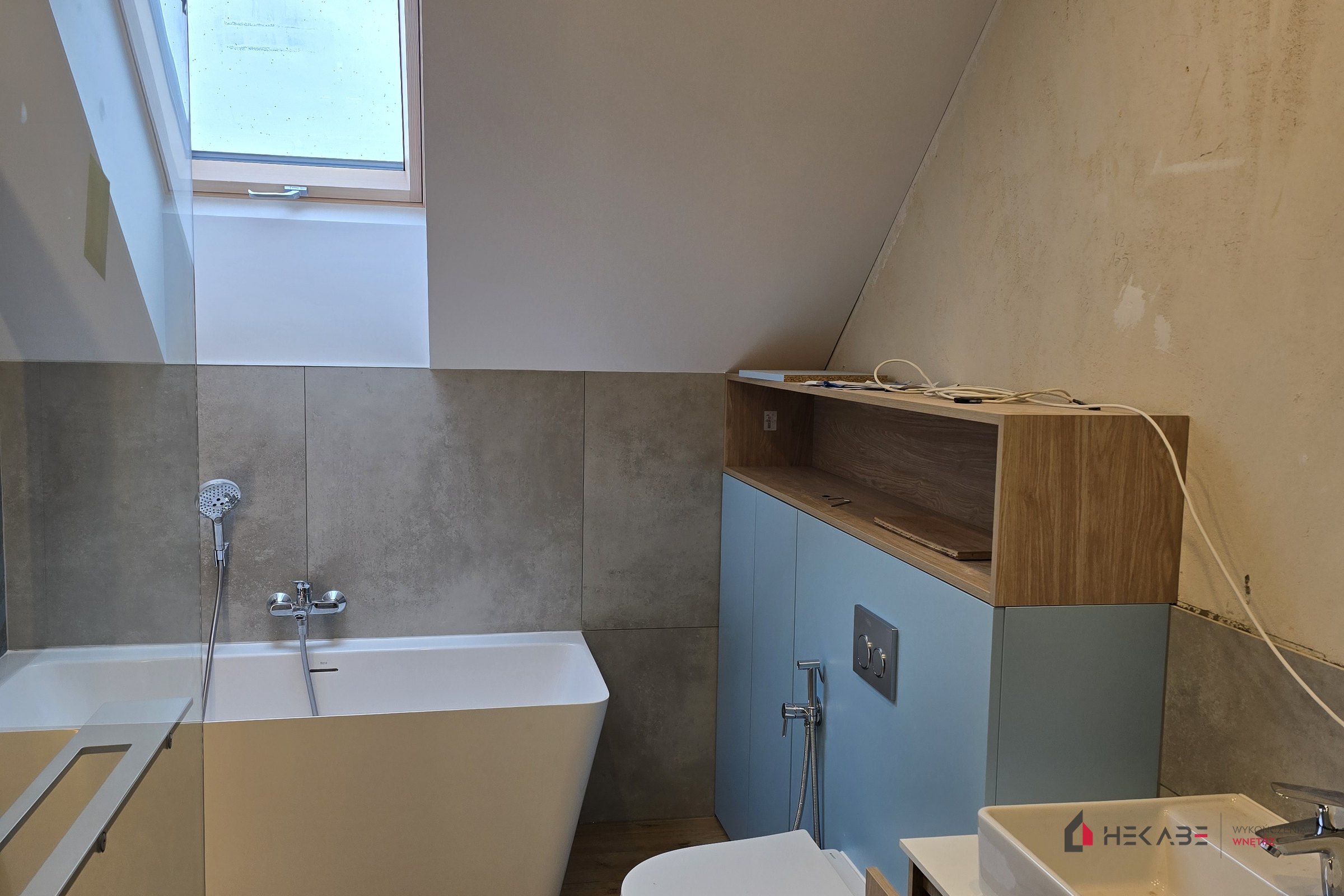
Microcement: where does it make sense?
Works well
- on walls and floors,
- in premium and minimalist zones,
- in coherent, calm interiors.
Requires special attention
- with weak substrates,
- in shower zones without proper waterproofing,
- when the work is being done as a “shortcut”.
Why does microcement in the bathroom attract investors?
The biggest advantage of microcement is visual coherence. The bathroom looks calmer, more modern and more “architectural” because instead of many cuts and grout lines, you get a uniform surface that combines well with glass, wood, stone and built-in furniture.
- fewer classic grout lines and divisions,
- a modern, calm visual effect,
- seamless connection of walls, floor and selected built-ins,
- great fit for minimalist, warm and premium bathrooms.
Where does microcement work best?
It’s not just a “decorative wall” material. Well-executed microcement can work on several types of surfaces in a single bathroom:
- on walls,
- on the floor,
- in the washbasin zone,
- on built-ins and shelves,
- in selected wet zones, including the walk-in shower.
In practice, it works best where the investor cares about material coherence and refined detail. If you want to see the effect in a real project, a good reference is Bathroom Gawronów.
The most important advantages of microcement in the bathroom
1. Coherent aesthetics
Microcement gives the bathroom a calmer rhythm and a more uniform character. This matters especially in smaller interiors, where many divisions visually break up the space.
2. Design flexibility
It combines well with wood, glass, black fittings, stone and joinery built-ins. This makes it easier to build an interior that doesn’t look like a set of random materials.
3. Suitable for various surfaces
This solution gives more freedom when designing transitions, recesses, shelves and custom elements than the classic combination of tiles and trims.
4. A premium effect without excessive decoration
For many investors this is an important advantage. Microcement gives a strong aesthetic effect, but isn’t loud. In a well-designed bathroom it can be the backdrop for light, fittings and built-in form.
Limitations: when is microcement not the best choice?
This is a very important part of the decision. Microcement isn’t a universal solution just because it looks good in inspiration shots. There are situations where it’s not worth choosing — or where execution must be approached with particular care.
- Weak substrate: if the base is unstable, cracked or poorly prepared, there’s no point pretending the finishing layer will “fix everything”.
- Lack of attention to detail: with microcement, transitions, corners, expansion joints and protections matter enormously.
- Wrong usage expectations: if someone wants a completely maintenance-free material that tolerates any neglect, it’s better to say so honestly at the start.
This is exactly why microcement should be planned with a contractor who understands the technology and can connect it with the design of the entire bathroom — not treat it as a “decorative effect from the catalogue”.
Is microcement suitable for a walk-in shower?
Yes, but it’s one of those areas where technology — not just appearance — matters. In the shower zone, what counts is:
- correct waterproofing,
- a stable and well-prepared substrate,
- proper falls,
- correct sealing of the final layers,
- execution accuracy in the details.
If any of these stages is treated as a “shortcut”, the problem doesn’t come from the material itself but from execution errors. That’s why in the bathroom, microcement should be planned together with the entire wet-zone logic.
What does microcement maintenance look like?
Microcement doesn’t require complicated handling, but it does require sensible care. It’s not a surface to clean with aggressive chemicals or to treat with random “all-purpose” agents.
The safest approach is:
- using mild agents for everyday cleaning,
- avoiding strongly caustic preparations,
- regularly drying intensively wet zones,
- following the recommendations issued after surface execution.
A well-executed and properly used surface keeps its aesthetics for a long time. The problem usually isn’t daily contact with water — it’s the wrong choice of chemistry or neglected details already at the execution stage.
How much does microcement in a bathroom cost?
This question comes up very early — and rightly so — but with microcement, the per-square-meter rate alone never gives the full picture. In practice, indicative costs for simpler projects usually start from around PLN 300–450 per m², and with more demanding zones, substrate preparation and elaborate details, the budget grows.
The final price is mainly affected by:
- substrate condition and the scope of preparation,
- whether it’s a wall, floor or wet zone,
- the number of corners, recesses and details,
- the size of the surface,
- the expected level of texture and finish.
So it’s best to treat this range as a reference point and base the final cost on a quote prepared for a specific bathroom.
Microcement or tiles?
This isn’t a “better or worse” choice — it’s a decision about a different effect and different way of use. Tiles are more classic and predictable for many contractors. Microcement gives greater visual coherence and a more architectural effect, but requires greater execution discipline.
If you want a more uniform, calm bathroom without an excess of grout lines, microcement can be a very apt choice. If your priority is the simplest and most standard execution model, tiles will still be a sensible option.
When is it worth combining microcement with the bathroom design?
Very often in practice. Microcement works best when it’s thought through from the start together with the interior layout, lighting, built-ins, fittings and usage zones. So it’s worth planning early — not as a decorative addition at the end.
If you’d like, we can combine such a solution with an interior design project, a wider scope of turnkey finishing or the local page microcement Katowice.
Microcement on the floor isn’t just a bathroom topic — see the full floor comparison: parquet, panels, vinyl and microcement with costs for Katowice.
An alternative to microcement is large-format porcelain stoneware — fewer grout lines, monolith effect, proven manufacturers.
Frequently asked questions
Is microcement suitable for a walk-in shower?
Yes, but only with a properly prepared substrate, waterproofing, falls and sealing of the final layers.
How much does microcement in a bathroom cost per m²?
Indicative ranges usually start from around PLN 300–450 per m², but with more demanding projects the cost grows.
Does microcement crack?
The problem isn’t the material itself — it’s mistakes in substrate preparation, expansion joints or execution technology.
How to clean microcement in the bathroom?
Best with mild agents, without aggressive chemistry, and following the recommendations issued after surface execution.
Want to check whether microcement makes sense in your bathroom?
If you’re planning a bathroom in Katowice or across Silesia, we’ll prepare a real technical assessment and quote — instead of promising a universal solution for every interior.
See also microcement in Katowice, the microcement service and Hekabe projects.
See also
If you’re planning interior finishing in Katowice or across Silesia, continue to related services, projects and other Hekabe guides.
Microcement works great in the shower zone — see how much a walk-in shower in Katowice costs and what technical solutions we use.